Montana Tech students learn movement science through atlatl and kayak challenges
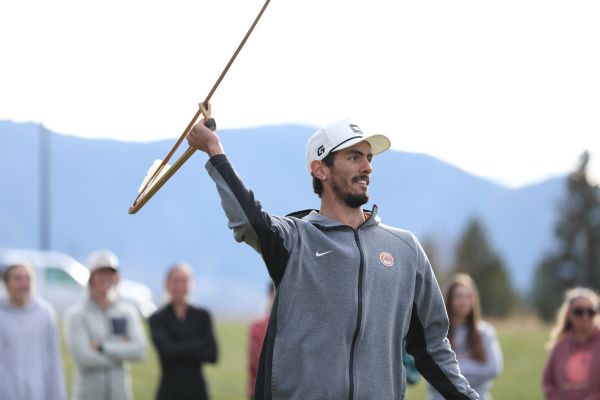
Montana Technological University students stepped back in time thousands of years this fall as they learned how to toss an atlatl, a prehistoric spear-throwing lever used by early humans and indigenous peoples around the world.
Surprisingly, this wasn’t a history lesson. The activity is part of Professor John Amtmann’s Kinesiology class.
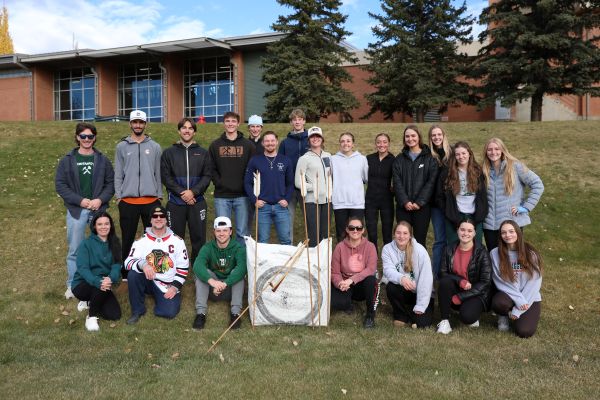
“This is a movement that was very important to the development of mankind,” Amtmann explained as students attempted to throw the primitive tool toward an archery target. “It’s directly related to kinesiology—the study of movement.”
Amtmann told the students if they hit the archery target they would be exempt from their final. Last year, no students were able to do so. This year, Kinnidi Willmore, a volleyball player from Claremont, California, studying exercise and health science, hit the target not once, but twice, earning the cheers of her entire class.
“It was really fun,” Willmore said. “I didn’t think I’d hit the target, but I did.”
Willmore connected the experience to the science behind the movement.
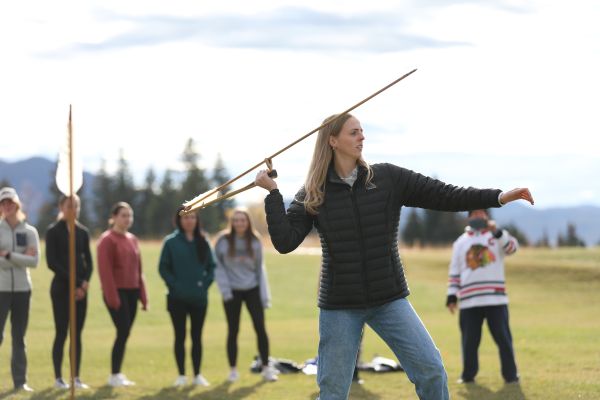
“Right now, we’re learning about shoulder muscles and their different movements and actions, and the radial ulnar joint also connects because it’s used on ulnar deviation,” Willmore said. “I think it’s really great John takes us outside to see this in action.”
The class was led by teaching assistant Matt Ashcraft, who received an atlatl from his parents when he was 10.
“It’s a little less intuitive than a bow and arrow where you can just kind of point and shoot.” Ashcraft explained to the students. “You want to keep everything straight, and then when you throw, your arm should be coming straight over — like a volleyball spike.”
The atlatl throwing is just one that the class uses that connects body movement with primitive or practical skills.
The class spent one session learning how to throw axes. Another was spent learning how to roll back into upright position from an upside-down kayak in the University’s pool.
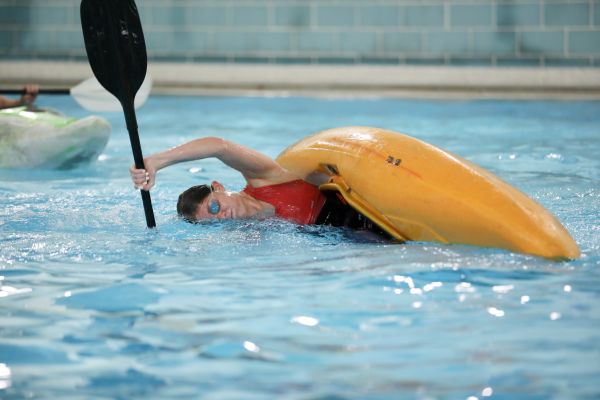
Lane Love, a basketball player, and exercise and health science student from Billings, was able to correctly roll upright on the first try, which also earned him an exemption from the semester final.
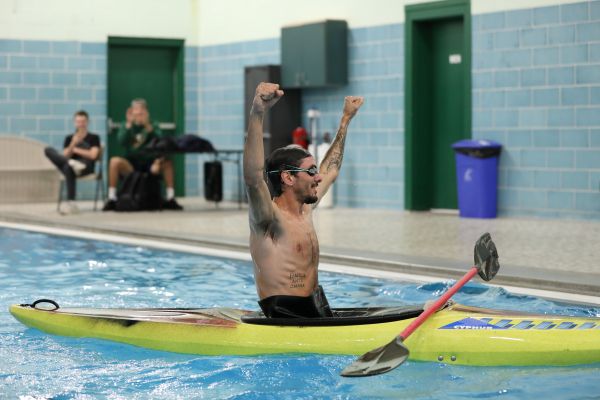
“It was actually super fun. I was pretty nervous before, but as long as you didn’t panic when you were on the water, it made it a whole lot easier,” Love said. “I told myself to take two seconds and get my composure before I even attempted to flip over.”
For Love, the exercise was about more than his personal achievement.
“The class was super fun,” Love said. “I thought it was cool how we were all working as a team and trying to get everyone to accomplish it.”
Montana Tech’s Exercise and Health Science undergraduate program prepares students for careers in exercise physiology and in medical fields such as physical therapy, occupational therapy, athletic training, physician’s assistant, and medicine. To learn more about the program that features hands-on and experiential learning, click here.